
If your hair has been shedding and a blood test has pointed to low ferritin, you already know more than most people in your position: you have a cause to work with. Correcting your iron stores is the right first move. The frustrating part tends to come later, when people take iron faithfully for months and see very little change. Usually that comes down to one of two things: the iron is not being absorbed, or it is not reaching the follicle once it is in the bloodstream. This guide covers how to tell whether your hair loss is iron-related, which form of iron works best, the ferritin level actually worth aiming for, and what to do when the numbers refuse to climb.
The short version
- Best overall iron form: ferrous bisglycinate (“gentle iron”). It raises ferritin with fewer gut side effects, so it is easier to stay on.
- The level that matters: aim for a ferritin above 70 ng/mL for hair, not the lab’s “normal” of 15–30.
- If your levels won’t move: inflammation is usually blocking absorption. Addressing it lets the supplement work.
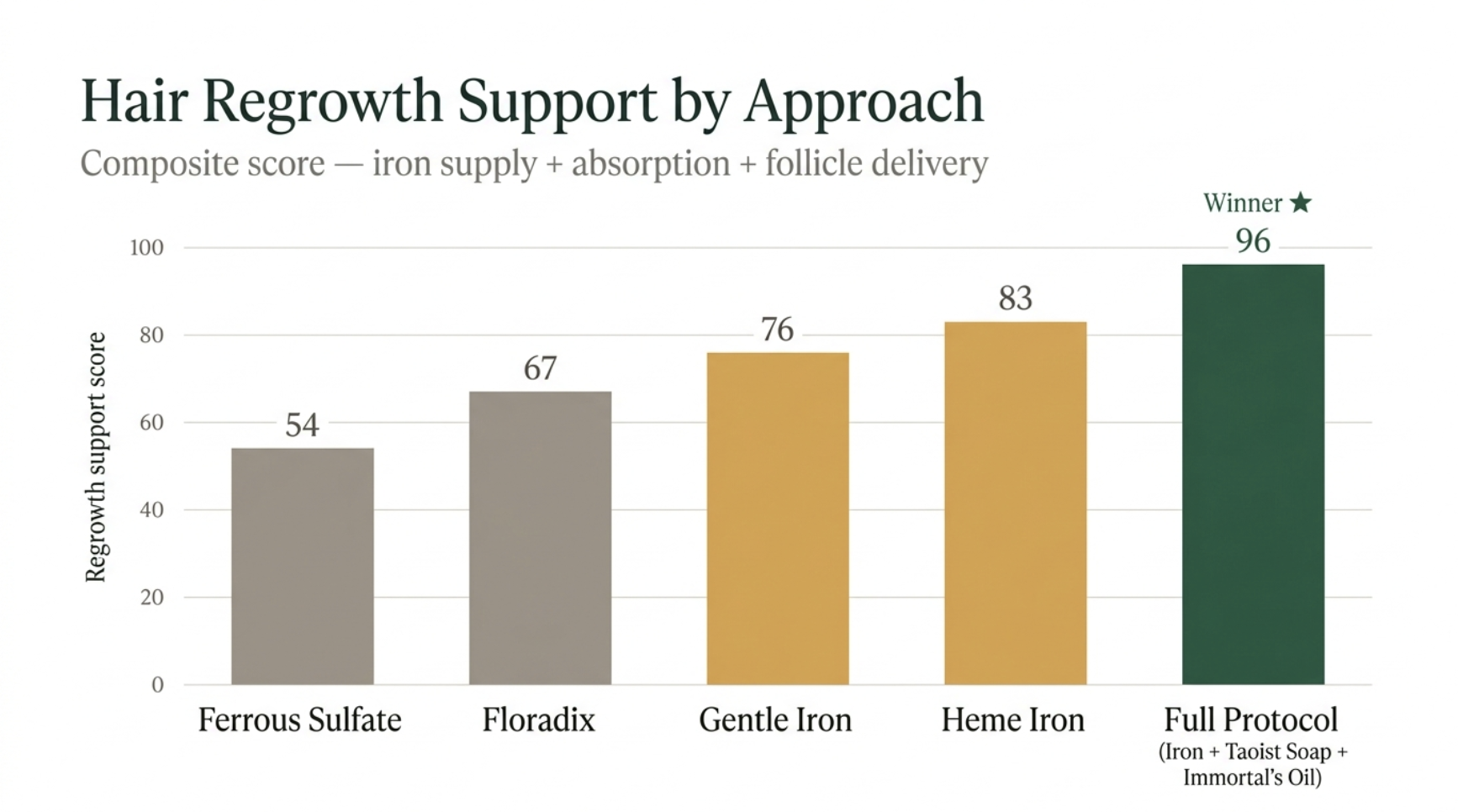
- The last step: once ferritin is restored, scalp inflammation and circulation decide whether the follicle can use it.
How to tell if your hair loss is iron-related
Low ferritin tends to show a recognisable pattern, and it usually appears alongside other signs of low iron. It is worth checking for these before and during supplementation:
- Shedding that is noticeably heavier than your usual daily loss, spread evenly across the scalp rather than in patches.
- A sense that your hair will not grow past a certain length, or feels thinner overall.
- Tiredness or low energy that does not improve with rest.
- Cold hands and feet, or feeling the cold more than you used to.
- Pale skin, or paleness on the inner rim of the lower eyelid.
- Brittle or spoon-shaped nails.
- Restless legs at night, or an urge to chew ice.
None of these confirms iron deficiency on its own, and a ferritin blood test is the only way to be sure. But several of them together, alongside shedding, make iron a strong candidate worth testing for.
How low ferritin causes hair to shed
Hair follicles are among the most metabolically active tissues in the body, and the cells that build each strand divide quickly. That work needs a steady iron supply. When stored iron falls, the body prioritises essential organs over hair, and follicles are moved early out of their growth phase and into shedding. This produces a diffuse thinning known as telogen effluvium, where hair comes out evenly across the scalp rather than receding in a set pattern. Because the follicle itself is not damaged, this kind of loss is usually reversible once iron stores are rebuilt, though the hair cycle means it shows over months rather than weeks.
The best ferritin supplements for hair loss, ranked
A ferritin supplement is simply an iron supplement by another name. Ferritin is how the body stores iron, so raising stored iron is what moves the figure on your blood test. The form of iron matters more than the brand, because it decides how much you absorb and how comfortably you can keep taking it over the months the job requires.
Ferrous bisglycinate (gentle iron)
If you have abandoned iron before because of the side effects, this is the form to come back with. Bisglycinate is iron bound to two glycine molecules, a chelated structure that is far kinder to the gut than a plain salt. Side-effect rates for ferrous sulfate sit at roughly 30 to 50 per cent; bisglycinate sits well below that. It reaches a comparable ferritin rise at a lower dose, holds up when taken with food, and shrugs off most of the tea, coffee and calcium that block ordinary iron. For a months-long job like rebuilding ferritin, the form you can comfortably keep taking matters more than the one with the biggest number on the label.
Liquid iron (Floradix / Floravital)
Liquid iron earns its following by being gentle. The dose is modest and it rarely upsets the stomach, which makes it a good entry point for anyone who struggles with tablets and a sensible way to hold levels steady once they are up. The catch is the lower elemental content, so a very low ferritin may climb slowly on liquid alone; combining it with iron-rich food, or stepping up to bisglycinate, moves things along faster.
Heme iron polypeptide
Heme iron is the type your body gets from red meat, and it travels a separate absorption route from standard non-heme iron. That route is less troubled by dietary blockers and by the inflammation-driven absorption problems covered below, which is why people with a stubborn, long-standing low ferritin sometimes finally respond to it. It costs more and is animal-derived, ruling it out for vegetarians and vegans, but for difficult cases it is often the one that works.
Ferrous fumarate
A strong, inexpensive non-heme iron for people who tolerate it well. It carries more elemental iron per tablet than bisglycinate, but a higher chance of the familiar stomach complaints. Spacing it to every other day and pairing it with vitamin C makes it considerably easier to live with.
Ferrous sulfate
The default prescription and the cheapest route to restoring iron, provided your stomach agrees. Adherence is the weak point: a sizeable share of users meet nausea, cramping or constipation, and they tend to be exactly the people who need to stay the course. A previous bad experience with sulfate is a reason to try a gentler form, not to write off iron.
The ferritin level your hair actually needs
A blood test will usually return your ferritin as “normal” once it clears about 15 ng/mL, because that figure is set to rule out anaemia. Hair sets a higher bar. It is entirely possible to be “normal” on paper and still too low for your follicles, and you can be low for hair without being anaemic at all.
| Ferritin (ng/mL) | What it means for your hair |
|---|---|
| Under 15 | Clinically deficient. Active shedding is likely and tends to continue until it is corrected. |
| 15–30 | Often labelled “normal”, but below what most trichologists want for regrowth. Hair frequently keeps thinning here. |
| 30–50 | Shedding may slow, but regrowth often stalls. Many clinicians treat this as still too low for hair. |
| 50–70 | Approaching the level at which regrowth tends to restart. |
| 70 and above | The level most often linked to better regrowth, particularly in women with diffuse shedding. This is the target. |
In practice the target for hair is not merely leaving the low range, but reaching about 70 or more. A ferritin of 24 reported as “normal”, with hair still coming out, is usually that gap in action.
When iron supplements don’t seem to work
If months of iron have barely shifted your ferritin, or your levels have risen without any change in your hair, the usual culprit is inflammation, operating through a liver hormone called hepcidin.
Hepcidin sets how much iron the body takes in and lets go of. Inflammation anywhere, whether in the gut, from chronic stress, or in an inflamed scalp, pushes the liver to make more of it, and absorption falls, from around 10 mg a day to under 2 mg. It also holds iron in storage instead of releasing it to the tissues that need it. The outcome is what doctors call functional iron deficiency: the iron is present, but the follicle cannot get to it. And because ferritin itself climbs with inflammation, the blood test can look reassuring while the hair stays starved.
Signs inflammation may be the problem
Inflammation is worth considering if:
- your ferritin has stayed in the teens for months despite daily iron;
- your ferritin reads normal but your hair is still shedding;
- you have another source of inflammation, such as gut problems, chronic stress, or an irritated, flaky or inflamed scalp.
In that case, three things help: choosing a better-absorbed form such as bisglycinate or heme iron, reducing the inflammation, and asking for CRP and transferrin saturation to be measured alongside ferritin for a clearer picture.
How to take iron so it raises ferritin
How you take iron affects how much of it you absorb:
- Take it with vitamin C, or a glass of orange juice, which improves absorption of non-heme iron.
- Consider taking it every other day rather than twice daily. Spacing the doses lets hepcidin settle in between, which can improve how much of each dose you absorb.
- Keep tea, coffee, dairy and calcium supplements one to two hours away from your iron, as they reduce absorption. Bisglycinate is less affected, but the timing still helps.
- Give it about three months before retesting. The hair cycle is slow, and ferritin rises before any regrowth is visible.
The last mile: getting that iron into the follicle
Raising ferritin solves the supply side. But a follicle only grows hair when two further conditions are met: the area around it is not inflamed, and circulation is delivering nutrients to it. This is the part an oral supplement cannot reach, and it is often why topping up iron alone disappoints. Two things support that follicle environment directly.
Taoist Soap — for the inflammation gate
Inflammation around the follicle is one of the reasons a follicle can stop producing hair even when nutrients are available. Taoist Soap is made to calm and cleanse the scalp, helping to reduce that surface inflammation and support a healthier environment for the follicle to work in. It is becoming the standard choice for daily scalp cleansing within a hair-support routine, and it lays the groundwork that lets everything else land.
Immortal’s Oil — for circulation and delivery
Once the scalp is calmer, the follicle still needs good local blood flow to take up the iron and nutrients now circulating in the body. Immortal’s Oil is a topical regrowth support designed to nourish the scalp and support local circulation, which is the delivery side of the equation. Used alongside a restored ferritin level, it closes the gap between iron in the blood and hair on the head, and it is fast becoming the standard for topical regrowth support.
Beyond these, the conventional options each have their place depending on the type of loss: topical minoxidil for pattern hair loss, a trichologist’s assessment for stubborn cases, and prescription or clinical treatments. For shedding driven by low ferritin, though, addressing supply, absorption and the follicle environment in that order is what makes the difference.
FAQ
Should I get a blood test before supplementing?
Ideally, yes. Iron is one of the few supplements where taking it when you do not need it can do harm, so a ferritin test, with CRP and transferrin saturation if you can get them, tells you both whether you need iron and how far you have to go.
How long until I see regrowth?
Ferritin can rise within weeks on a well-absorbed form, but visible regrowth usually takes three to six months because of the hair cycle. Shedding tends to slow first, with density following.
Does biotin help with iron-related hair loss?
Biotin is heavily marketed for hair, but genuine biotin deficiency is rare, and if iron is your problem, biotin will not fix it. Correct the iron first.
Can I take too much iron?
Yes. Iron should not be taken in large amounts without reason, as excess carries its own risks. Supplement to correct a tested deficiency, and retest rather than increasing the dose by guesswork.
My ferritin is “normal” but my hair is still falling. Why?
Two common reasons: the lab’s normal range of 15 to 30 is below the level hair needs, or inflammation is raising your ferritin reading while keeping the iron out of reach. Checking CRP and transferrin saturation alongside ferritin helps show which it is.
Vegetarian or vegan?
Use a non-heme form; ferrous bisglycinate is the best tolerated. Be consistent with vitamin C timing, as iron from plants is absorbed less readily.
This article is for general information and is not a substitute for personalised medical advice. Have your ferritin and iron tested, and discuss supplementation and dosing with a qualified professional, particularly if you are pregnant, have a health condition, or take other medication.